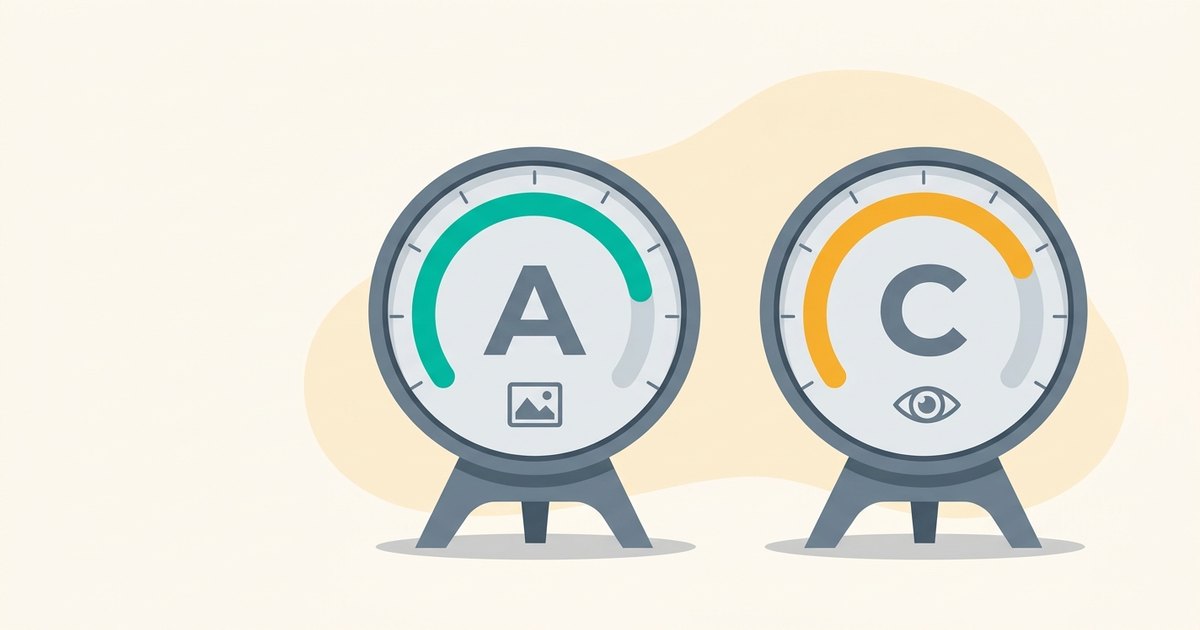
An analyse report has always given you a grade for each category — Privacy, Origin, Manipulation, Security. What it never told you was how much to trust that grade. An F built on a passport photograph's GPS coordinates and an F built on a statistical texture test are not the same finding, and until now the report presented them identically.
From this week, every grade carries a confidence beside it.
Two questions, not one
A forensic result is really answering two separate questions, and squeezing them into one letter loses information.
How much did we find? That is the grade. More findings, or more serious ones, move it.
How much can the checks be trusted? That is the confidence. It has nothing to do with how bad the finding is. A check that reads a fact out of the file — this image contains GPS coordinates, this signature verifies — is very hard to fool. A check that infers something from pixel statistics can be misled by an ordinary photograph that happens to look unusual.
So a high-confidence C and a low-confidence F are genuinely different situations, and you should treat them differently. The report now says which one you are looking at, on every card and in every detailed section.
Sometimes the honest answer is "we have not measured that"
The chip you may find most interesting is the one that reads No confidence stated.
It is not a fourth, lowest rating. It means we have not measured how reliable that particular assessment is, so we are not going to put a number on it. Inventing one would claim a precision the evidence does not support — and a made-up confidence is worse than no confidence, because it looks authoritative.
We would rather show you the gap than paper over it.
Nothing on the report is decorative any more
The second change is less visible and matters more.
Previously a handful of checks appeared on the report and contributed nothing at all to the grade. They were shown, they looked meaningful, and they were quietly ignored by the scoring. That is the worst of both worlds: you read a finding and reasonably assume it counted.
Every check that reaches your report now contributes something. Where a check is weak, it contributes very little — some of them move a grade by a hundredth of a point, which is close to nothing, and deliberately so. But close to nothing and nothing are different statements, and the weight now reflects what each check is actually worth.
That also puts every one of them under the same scrutiny: a severity that has to be justified, a confidence that has to be defended, and an automated check that fails our build if a signal disappears from the report by accident.
New this release
Illustration and animation detection, on photos and video. Reports now tell you whether the content looks like a photograph or a drawing, screenshot, diagram or rendered graphic — and for video, whether it is live footage or animation. The video half samples frames across the clip and takes a majority, so a single fade-to-black or title card does not tip the answer.
It reads with care, and the report says so: a photograph of a drawing is still a photograph, and roughly one in seventeen ordinary photographs is flagged this way. It is a signal, not a verdict.
JPEG encoder fingerprinting now counts. Where the way an image was encoded matches a known piece of software, that now contributes to the Origin grade rather than sitting on the page as an observation.
Why we are telling you about the plumbing
Most product updates are about new capability. This one is mostly about being able to show our working.
Every check that informs a grade now has a recorded reason for the weight it carries and the confidence it is given, and where that reason is "we measured it", we can say what we measured. Where it is "we have not measured it yet", the report says that too, in the place where you would otherwise have assumed otherwise.
If you use these reports to make a decision about a file — whether to publish it, whether to trust it, whether to strip its metadata before sending it on — that difference is the whole point.
Your existing reports will show the new confidence chips the next time you open them. Some grades have shifted slightly as a result of the weighting changes; the underlying findings have not changed.